The shopper landscape has changed dramatically over the decades, yet one principle remains remarkably consistent: the faster you sell, the more you sell. Retail performance often comes down to reducing friction. When the path to purchase feels easier, shoppers are more likely to move forward.
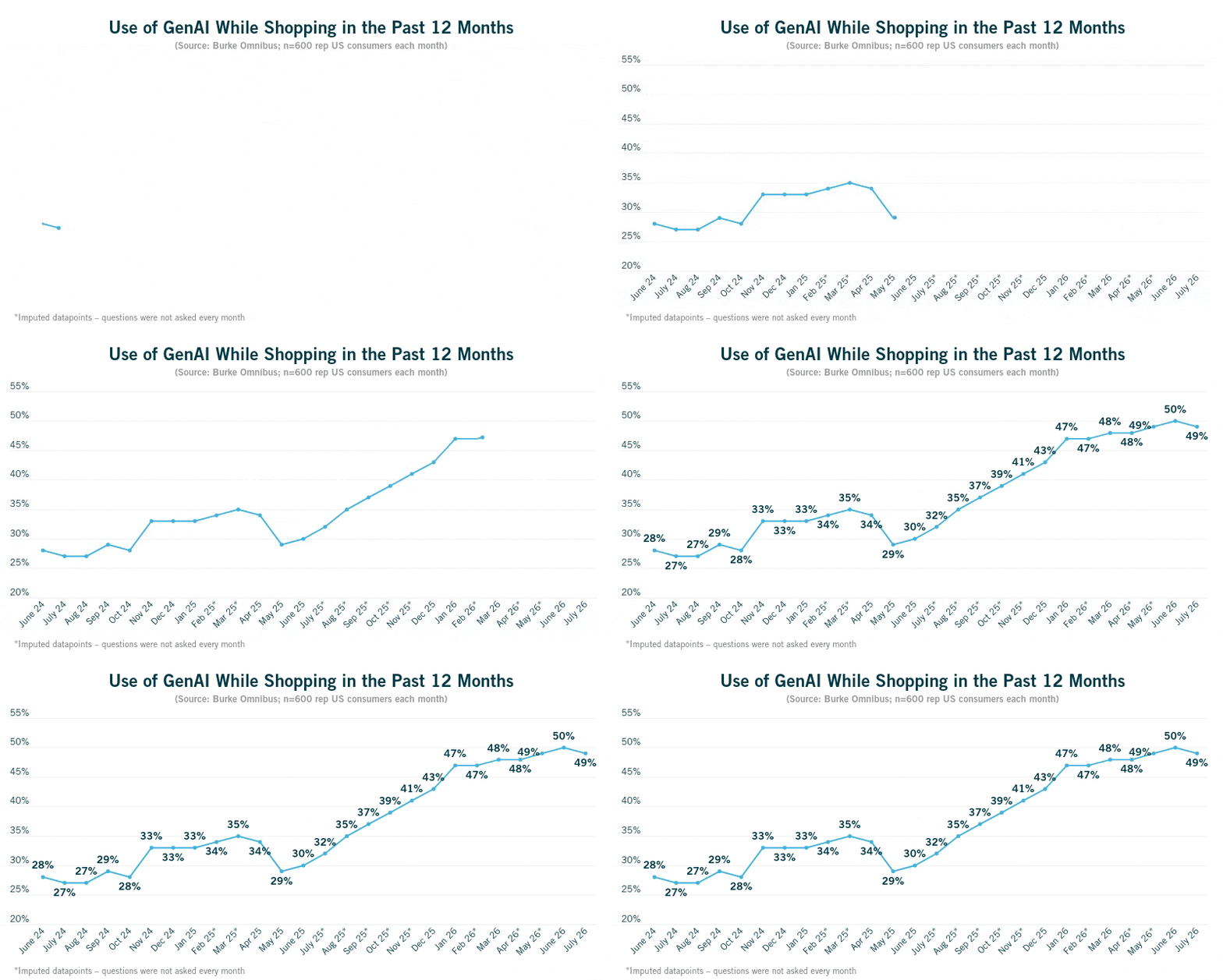
That is what makes the rise of Generative AI platforms especially relevant. Their ability to reduce friction can address multiple shopper tensions at once, from simplifying search to accelerating comparison and even decision-making. Our latest R&D data reflects this shift: nearly half of consumers are now using AI while shopping, and 84% say it makes the experience faster.1
This trend creates a profound shift in the way brands need to think about retail visibility. To win, brands must now market to two distinct audiences: the human shopper, or “The Mind,” who needs trust, relevance, and a seamless path to purchase; and the Large Language Model, or “The Model,” where brands need to be the definitive answer to a shopper’s questions.
To help brands navigate this new reality, we have pressure tested several of our behavioral science-based shopper truths. Our results reveal significant similarities and differences between these two distinct audiences.
The Similarities: Where the Model Mirrors the Mind
When we evaluate reasoning of Large Language Models (LLMs) against shopper truths, we find that algorithms and humans share several similarities, though they arrive at them for entirely different reasons.
Shopper Truth #1: Shoppers have limited ability to focus, so structure and simplicity wins.
THE MIND: Human attention spans have plummeted from 150 seconds in 2004 to just 47 seconds today. To prevent cognitive overload, shoppers scan and filter and don’t digest a lot of the information provided at retail.
THE MODEL: LLMs are also scanners of data, driven by the need for processing speed. The algorithm prioritizes structured data (e.g., comp-charts, listicles, FAQs, etc.) and is prone to parsing only the first or last 10% of a large block of text. 2
Shopper Truth #2: Shoppers follow the crowd to mitigate risk, so showing up well is critical.
THE MIND: Social proof, both explicit and implicit, is a vital conduit to trust; 93% of consumers say ratings and reviews influence their decisions. Prominence in search results or in shelf placement implies preference, and also influences consumer choice. 3
THE MODEL: LLMs crowdsource trust as well—89% of Gen AI links are sourced directly from earned media and user-generated content favoring real-world experiences such as product comparisons, Wikipedia results, and Reddit posts. 4
Shopper Truth #3: Laziness dictates navigation, so prominence and technical cues are key.
THE MIND: Humans want quick shortcuts; they read minimal text in-store (an average of 8 words on a 20-min grocery trip) and instead use pack color/shape cues to navigate. Shopper behavior looks similar online where the first three items in a search capture 64% of all clicks.5
THE MODEL: LLMs are also text-lazy; AI won’t waste processing power trying to decode unstructured HTML or messy URLs. If a page lacks a logical URL taxonomy, explicit Schema markup, and clear conversational text, the AI crawler simply skips it.
Shopper Truth #4: Shoppers need context to bridge the gap to a solution, so visual, written, and verbal storytelling still influences choice.
THE MIND: Humans sometimes struggle to imagine how a standalone product can work into their lives. They require lifestyle imagery or cross-merchandising vignettes to understand the real-world possibilities of a product.
THE MODEL: Context helps LLMs in much the same way, but the context for the AI is provided by the shopper when they enter a prompt (e.g., “lightweight vacuum for an apartment with shedding pets”). The LLM is designed to pick apart this query looking for explicit, functional context to make the best match between its recommendation and the shoppers use case.
In short, brands that want to appeal to LLMs can rely in part on the same proven tactics used to engage human audiences but with a focus on making tactics machine-readable. For example, keep content simple and structured, build trust through credible third-party signals, use clear labels and URLs to create shortcuts, and express context through explicit, use-case-driven product descriptions.
The Differences: Where the Paths Diverge
Testing our shopper truths also reveals differences between human psychology and algorithmic data-processing.
Shopper Truth #5: Humans crave familiarity, while the machine craves recency.
THE MIND: Consumers seek the familiar, relying on habit and brand loyalty to reduce daily decision fatigue and often resort to choosing the known product.
THE MODEL: On the contrary, LLMs operate on temporal decay, weighting newer data heavily to ensure relevance. With the possibility of autonomous shopping by AI agents looming, this could trigger a massive loyalty crisis as agents make purchases based on real-time specs and utility versus brand familiarity and loyalty.
Shopper Truth #6: “A picture is worth a thousand words,” but for humans the picture taps emotion while AI uses images as data.
THE MIND: For humans, visuals effectively communicate product details but also drive emotional association. An aspirational image of a hiking boot on a misty mountain might also make a consumer associate “adventure” with a particularly brand.
THE MODEL: For AI, images are data. The same image of a boot on a mountain is used by an LLM to objectively check technical features against the text. AI will use the image to confirm the tread depth or color of the hiking boot all in an effort to ensure an accurate recommendation.
Shopper Truth #7: Humans “deselect” while AI ranks and filters infinite possibilities.
THE MIND: For humans too much choice is seductive, but ultimately overwhelming, so we use mental shortcuts and leverage visual cues (like contrasting color, bold typography), and simplified claims deployed through instore merchandising and packaging design help to “deselect” and eliminate options.
THE MODEL: Unlike humans, AI doesn’t feel overwhelmed by hundreds or thousands of options. It simply treats them as a massive list of candidates to be systematically graded, ranked, and sorted from top to bottom ultimately arriving at the solution that best fits the need.
Shopper Truth #8: Shoppers don’t do the math, but AI does.
THE MIND: Shoppers rarely analyze prices in detail, relying instead on framing cues like anchoring via first price shown tactics or decoy effect tactics where less attractive options are served up to nudge a shopper to specific options.
THE MODEL: LLMs are unemotional about price. They do the math—and they do it instantly. AI doesn’t get swept up in the psychological relief of a bargain, nor is it tricked by a premium decoy. An LLM systematically calculates price-to-weight ratios, cost per ounce, historical price tracking, and feature-by-feature utility metrics. It evaluates pricing with objective, linear logic, rendering traditional psychological price strategies ineffective.
Overall, similarities exist between humans and LLMs, but the underlying mechanics of decision-making differ significantly. Humans rely on emotion, memory, and cognitive shortcuts to navigate complexity, whereas LLMs prioritize structured, verifiable, and up-to-date information. What captures human attention does not influence an algorithm in the same way.
Conclusion
In many ways it seems like marketing needs to return to basics, with a mind to adapting tactics to better align with how LLM’s process information and make recommendations. Imagine returning to a time before activity and noise kept a brand top-of-mind, when brands focused on meeting customer needs in unique ways.
Because to capture attention of the model, you must provide bulletproof, well-structured data and verifiable proof of utility to climb the algorithmic rankings.
To capture the mind, you must continue to build trust, trigger the right emotional associations, and deliver the seamless, high-quality outcomes that humans demand.
In parallel, the need to consider both audiences to win with retail visibility means developing methods and tools to monitor both. Consumer insights are only part of the story, especially as human use of LLMs to make decisions increases and the promise of autonomous agents becomes reality. Insights professionals must now segment and measure human behavior and algorithmic behavior. Brands must now also track a brand’s “share of voice” within LLM responses, audit how effectively digital assets are parsed by AI crawlers, and measure the shifting friction points of an AI agent-enabled purchase journey.
Bottomline: The future of retail visibility belongs to the brands that know how to balance both the universal truths of human psychology and the cold, hard logic of the machine.
James Sorensenhas been shaping shopper insights since 1993. He began his career with Sorensen Associates, a leader in in-store research, and later led Kantar’s shopper insights practice. Today, James brings this deep expertise to Burke, serving as a trusted advisor in retail and shopper insights—helping clients uncover innovative, actionable strategies for growth.
Eric Scheer is SVP, Brand Solutions at Burke, Inc. Drawing from over 20 years of experience, Eric is especially good at solving brand challenges. Having been an entrepreneur, combined with extensive branding, design, and strategy experience, Eric has the know-how and strategic approach to conquer any obstacle your brand may encounter.
Interested in reading more? Check out James and Eric’s other article:
Sources:
1. Burke, Inc. Burke Omnibus Research Survey. June 2024 – March 2026. Dataset.
2. Mark, G., Gonzalez, V. M., & Harris, J. (2005). “No task left behind? Examining the nature of fragmented work.” Proceedings of the SIGCHI Conference on Human Factors in Computing Systems, 321–330.
3. Zhong-Gang, Y., et al. (2015), cited in “The Impact of Online Reviews on Consumers’ Purchasing Decisions.”Frontiers in Psychology, 2022
4. Muck Rack. (2025). What is AI reading? Understanding generative AI pulse and citation trends. Muck Rack Research Reports. https://muckrack.com/research/what-is-ai-reading
5. Profitero Cross Category Analysis. (2026). The 2026 Digitally Influenced Shopper. Profitero Cross Category Analysis.
Feature Image – Woman Shopping Online. [AI-generated image created by Monica Salsbery using Midjourney v6.0, 2026]. Prompt: “woman on phone relaxing on couch comparing clothing items to purchase on phone show screen”
https://www.burke.com/wp-content/uploads/2026/06/2026-conference-BYM-Graphic-1.png8001200Jenna Brookshttps://www.burke.com/wp-content/uploads/2024/01/BurkeLogoR-forsite.pngJenna Brooks2026-06-12 15:00:452026-06-16 14:33:01Reflections from Building a More Connected Insights Ecosystem
https://www.burke.com/wp-content/uploads/2026/05/AdobeStock_449752604-web.png8001200Monica Salsberyhttps://www.burke.com/wp-content/uploads/2024/01/BurkeLogoR-forsite.pngMonica Salsbery2026-05-28 15:03:262026-06-15 13:41:56Your Data Strategy is Your Intelligence Strategy
To provide the best experiences, we use technologies like cookies to store and/or access device information. Consenting to these technologies will allow us to process data such as browsing behavior or unique IDs on this site. Not consenting or withdrawing consent, may adversely affect certain features and functions.
Functional
Always active
The technical storage or access is strictly necessary for the legitimate purpose of enabling the use of a specific service explicitly requested by the subscriber or user, or for the sole purpose of carrying out the transmission of a communication over an electronic communications network.
Preferences
The technical storage or access is necessary for the legitimate purpose of storing preferences that are not requested by the subscriber or user.
Statistics
The technical storage or access that is used exclusively for statistical purposes.The technical storage or access that is used exclusively for anonymous statistical purposes. Without a subpoena, voluntary compliance on the part of your Internet Service Provider, or additional records from a third party, information stored or retrieved for this purpose alone cannot usually be used to identify you.
Marketing
The technical storage or access is required to create user profiles to send advertising, or to track the user on a website or across several websites for similar marketing purposes.





 https://www.burke.com/wp-content/uploads/2026/06/AdobeStock_561028135-web.png
800
1200
Jenna Brooks
https://www.burke.com/wp-content/uploads/2024/01/BurkeLogoR-forsite.png
Jenna Brooks2026-06-16 09:48:362026-06-30 14:29:16The Rise of AI-Moderated Interviews
https://www.burke.com/wp-content/uploads/2026/06/AdobeStock_561028135-web.png
800
1200
Jenna Brooks
https://www.burke.com/wp-content/uploads/2024/01/BurkeLogoR-forsite.png
Jenna Brooks2026-06-16 09:48:362026-06-30 14:29:16The Rise of AI-Moderated Interviews